
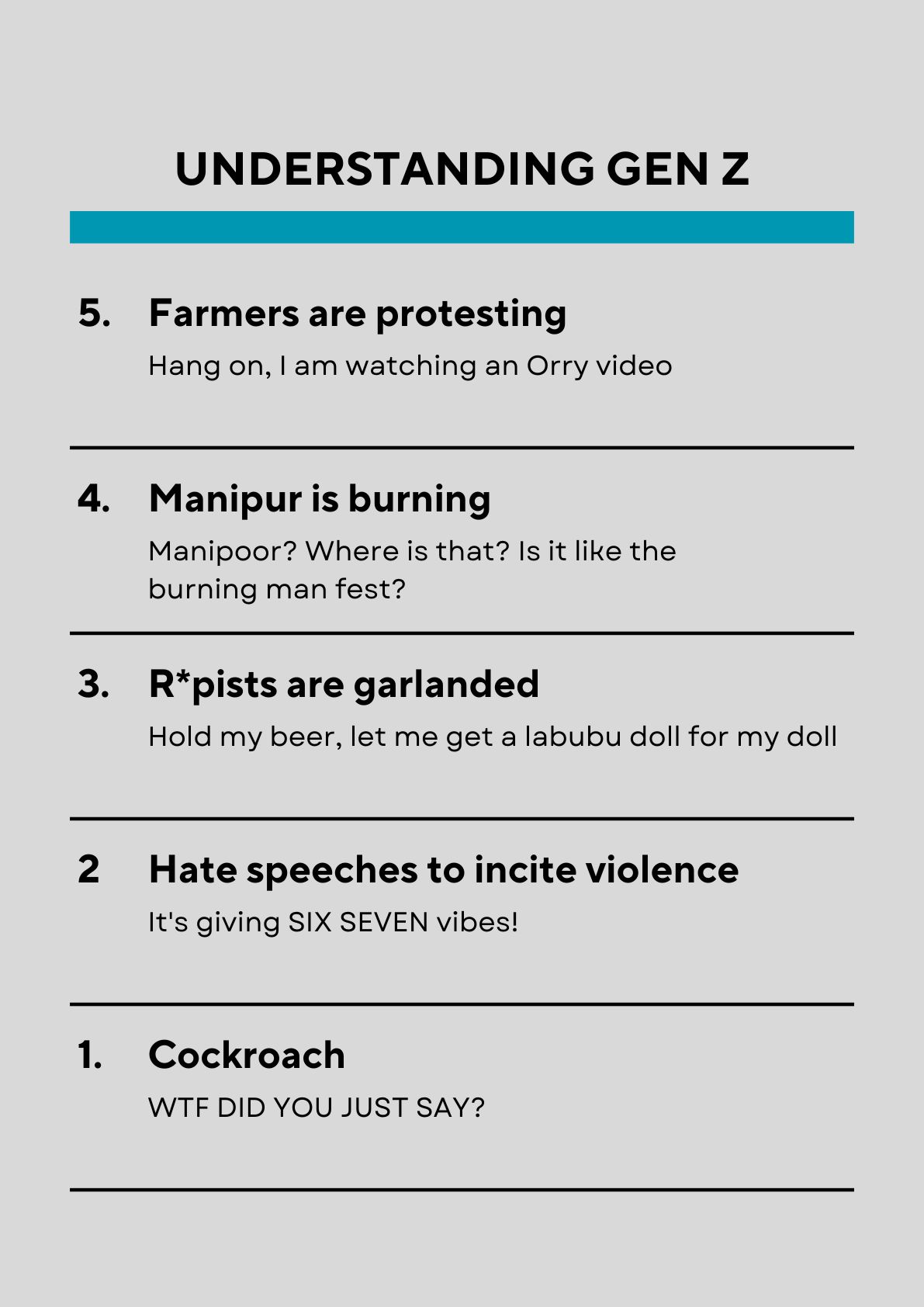
Farmers have been on highways. Manipur has been on fire. Men who assault women have received garlands instead of sentences. Speeches designed to make one community afraid of another have been delivered at microphones, on record, without consequence.
None of it moved the dinner table.
One word did.
I’m not here to mock that. I’m here to sit with it, because I think it tells us something important, not just about a generation, but about how political consciousness actually works in human beings.
The word “cockroach” landed differently because it was personal. Not personal in the way that a policy affects your livelihood or a conflict displaces your neighbor. Personal in the way that a slur reaches into your identity and squeezes. Manipur is a crisis of geography. Cockroach is a crisis of self.
This isn’t a Gen Z failure. It’s a human one. There’s a well-documented phenomenon in psychology called the identified victim effect. We respond with far more urgency to one named, visible target of harm than to thousands of anonymous ones. One death is a tragedy. A million is a statistic. That’s not a Gen Z problem. That’s the operating system.
What the CJP moment reveals is that for a generation raised on identity-first discourse, the fastest path to political activation isn’t systemic injustice. It’s identity insult. Call a community a pest, and suddenly everyone who belongs to that community, or feels adjacent to it, has a political opinion.
Which raises the question nobody is asking at dinner: what happens after the insult fades?
Outrage sparked by identity tends to have a specific shelf life. It burns hot, organizes fast, trends well. And then, when the immediate insult is addressed or absorbed or simply replaced by the next news cycle, the energy disperses. Because the people who showed up for the identity insult were never necessarily there for the larger argument. They were there for themselves.
This is not cynicism. It’s pattern recognition.
The farmers who blocked highways were fighting a structural economic battle. That required sustained attention, an understanding of MSP, procurement policy, the politics of subsistence agriculture. It asked something of you cognitively. The cockroach moment asks only that you feel something. And feeling is always easier than understanding.
So here is what I actually want to know: is the CJP conversation at your dinner table about the word, or about what the word represents? Are people talking about the political philosophy that produces that kind of language, the conditions under which a public figure feels comfortable using it, the ecosystem that normalizes it? Or are they just angry that someone said it?
Because one of those conversations leads somewhere. The other one is just dinner.
There’s a useful thought experiment here. Line up the last decade in a room. Unemployment at levels that make the data embarrassing to publish. Retail inflation quietly eating into every middle-class kitchen. A rupee that has shed a third of its value against the dollar with no public explanation. A Prime Minister who has not held a single press conference in over ten years. Electoral funding made deliberately opaque. A surveillance scandal involving phones of journalists and opposition figures. A demonetization that wiped out livelihoods overnight and was never honestly audited. Farmers who camped on a highway for over a year. A state that burned for months while Parliament discussed other things. Perpetrators of assault being felicitated. Bulldozers used as instruments of selective justice.
And then the report cards from the rest of the world: Press Freedom, 151 out of 180 countries. Global Hunger Index, 102 out of 123, in the “serious” category, behind Bangladesh, Nepal, and Sri Lanka. World Happiness Report, 118 out of 143. Human Freedom Index, 110 out of 165. Gender Gap Index, 131 out of 146. Freedom House rates India “Partly Free.” The Economist Intelligence Unit lists it as a “Flawed Democracy.”
Ask a room of twenty-somethings to rank any of these by the urgency they felt in their gut.
Then add one word to the list.
The rankings will shift. You already know which way.
That asymmetry is the thing worth staring at. Not because the outrage over the word is wrong, but because the relative silence over everything else deserves an honest explanation, not a defensive one. If the answer is “we didn’t know,” that’s a media literacy problem. If the answer is “we knew but it didn’t feel like it was about us,” that’s something more uncomfortable to sit with.
The question is not whether a generation cares. Clearly, under the right conditions, they do. The question is whether caring about being called a cockroach will translate into caring about the things that were happening long before the word was said.
That’s the harder ask. That requires reading, not reacting. Longitudinal attention, not a trending hashtag. Whether it happens is the only political question that actually matters right now.
